374 Musing 23 Jul 2026
source · simonwillison.net ↗
Simon: Let’s talk a little bit about the human element. A lot of people are feeling a sense of loss now that so much of what they considered to be their role in building software is being subsumed by the models. How do you think about that? How has the past year and a half changed the way you think about your own craft and the value that you add? Thariq: Cat and Boris are such good reminders that you have to be more…
keep reading — 2 min ↗
360 Musing 21 Jun 2026
She sat on the bench opposite, the wood damp through her wool trousers – the Jigsaw ones from three years ago, back when she still believed dressing like a senior partner might hasten becoming one. Fake it till you make it, they said. But her Nani had warned her once, in that quiet voice that meant listen carefully: Watch what face you wear too long, beti. It starts to eat the one underneath. -- From the essay.
keep reading — 5 min ↗
358 Musing 13 Jun 2026
source · open.substack.com ↗
I have a theory that AI will make a lot of things that are otherwise illegible or partly legible, and in doing so can have unpredictable consequences on our society. And anyway, that's a theory, and I wrote about it.
keep reading — 1 min ↗
357 Musing 11 Jun 2026
With each passing day, the dominant discourse about large language models continues to annoy me. On one side, you have the boosters. On the other side, you have the doomers. One side confidently asserts that this marks the twilight of the humans. The other side makes roughly the same argument, but in a doom-and-gloom…
keep reading — 4 min ↗
354 Musing 03 Jun 2026
I was playing around with visualizing economic data, and I needed a cheap LLM to digitize or extract text from really old scanned PDFs. I experimented with Gemini 3.1 Flash Lite. It’s a small, ultra-cheap model, but I was surprised by how good it was at extracting clean, high-quality, well-formatted text from really…
keep reading — 1 min ↗
352 Musing 30 May 2026
source · amp-scmp-com.cdn.ampproject.org ↗
Chinese AI developers are increasingly pivoting from general-purpose chatbots towards embedding voice AI assistants into daily applications in search of broader commercial uses for generative AI technologies. The growing industry focus on speech models reflects expectations that voice interfaces could become a key gateway for deploying AI across industries. As one of the most intuitive forms of human-computer interaction,…
keep reading — 1 min ↗
345 Link 19 May 2026
Ken Griffin: Let me share a few thoughts on this. First, over the last few months, there has been a step-change function in the productivity of the AI toolkit. It is profoundly more powerful than it was just nine months ago. At Citadel, that has allowed us to unleash a much broader array of use cases, and it has been really interesting to watch. To be blunt, work that we would usually assign to people with Master's degrees…
keep reading — 5 min ↗
337 Musing 09 May 2026
source · x.com ↗
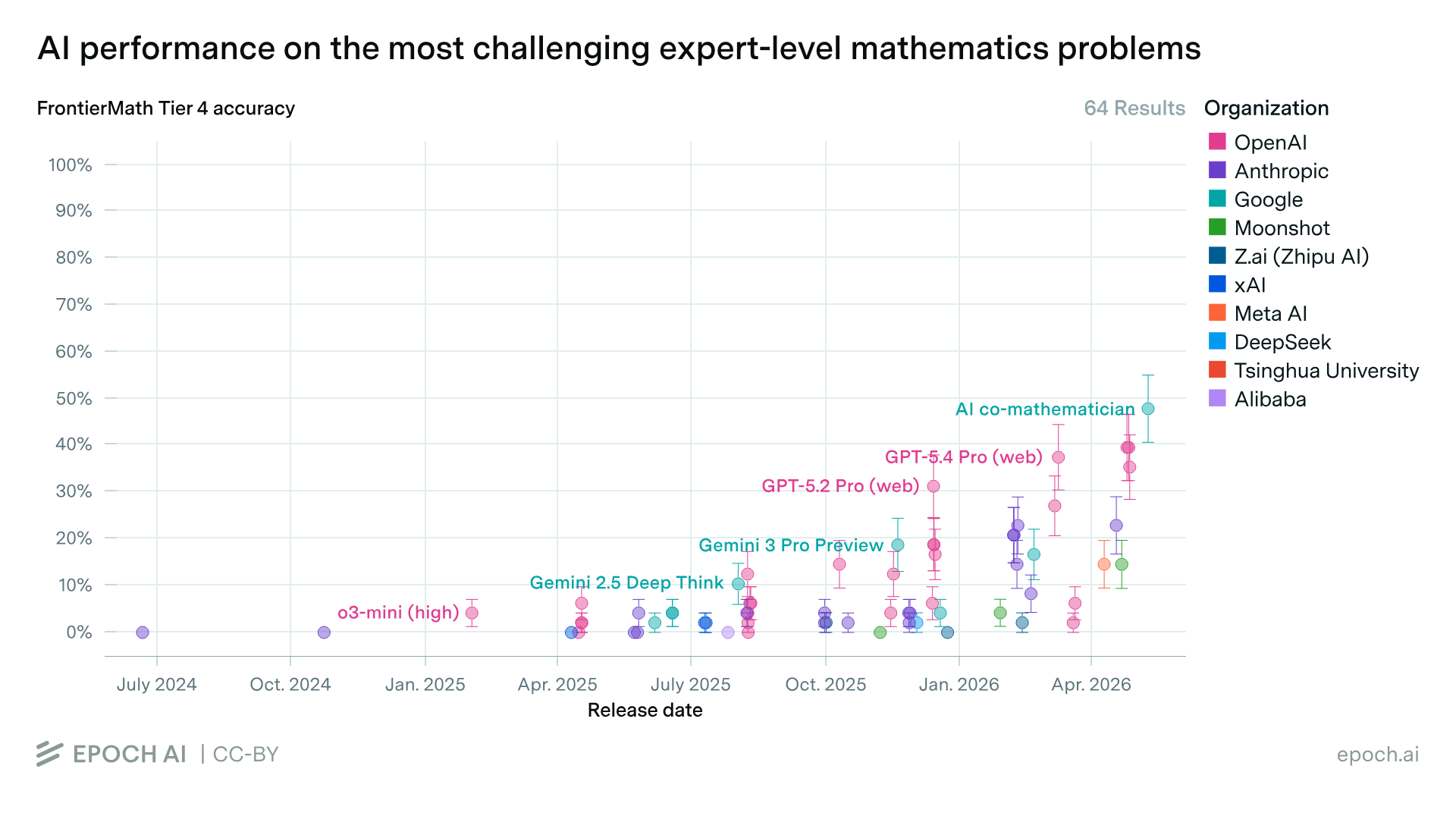
The future of Math is mathematicians and AI agents working together. Very pleased to introduce @GoogleDeepMind's AI co-mathematician: a multi-agent system designed to actively collaborate with human experts on open-ended research mathematics. Mathematicians testing the agent across areas as diverse as group theory, Hamiltonian systems, and algebraic combinatorics have reported impressive results. In autonomous mode evaluation…
keep reading — 1 min ↗
326 Link 22 Apr 2026
source · addyosmani.com ↗
A decent model with a great harness beats a great model with a bad harness. I’ve watched this play out on my own work over and over. And increasingly the interesting engineering isn’t in picking the model, it’s in designing the scaffolding around it.
keep reading — 1 min ↗
324 Link 21 Apr 2026
source · x.com ↗
This is the first open-weight model that plays like a top-class agentic model. Watching it go through ambiguous and meticulous chained tool work successfully puts it squarely in the wheelhouse of Opus 4.6. We're looking at an open weight model, but with much cheaper direct inference provider pricing. For a subclass of our eval set, it's outperforming GPT 5.2. We're about to undergo a gigantic industry shift.
keep reading — 1 min ↗
313 Musing 04 Apr 2026
source · x.com ↗
Good advice. This is a major regime change, you can do things in one evening now, that would take months before. I agree with the notion — even if nobody knows at this point where this goes — that it makes a lot of sense to invest a lot in knowing how to use these tools. Then the biggest bang for the buck will be conceptual ideas, posing useful question, the returns on investing in technicalities, and very specialized…
keep reading — 1 min ↗
301 Link 26 Mar 2026
source · ofdollarsanddata.com ↗
Some will argue that “this time is different” because AI is replacing knowledge work, not just physical work. And, if this comes to pass, what will there be left for people to do? It’s a compelling argument, but people made similar arguments about the automation of physical work. There was literally a group of people in England in the early 1800s called the Luddites who destroyed weaving machines due to their adverse impact…
keep reading — 1 min ↗
297 Link 18 Mar 2026
Jensen in the Arena Om Malik on OpenAI's IPO plan Where OpenAI’s technology could show up in Iran
keep reading — 1 min ↗
273 Link 01 Mar 2026
source · x.com ↗
4w ago I was a Claude Code skeptic. I'm not a coder. None of the use cases were relevant. I managed teams & projects, drowning in email & overdue reminders. So I tried creating tools that would help me and... holy crap. Now I'm sharing the tools I built:
keep reading — 2 min ↗
272 Link 28 Feb 2026
source · theatlantic.com ↗
Tao: Today there are a lot of very tedious types of mathematics that we don’t like doing, so we look for clever ways to get around them. But AIs will just happily blast through those tedious computations. When we integrate AI with human workflows, we can just glide over these obstacles. I also think mathematicians will start doing math at larger scales. Think about the difference between case studies and population surveys in…
keep reading — 1 min ↗
271 Link 27 Feb 2026
source · x.com ↗
Before the industrial revolution, humankind had to work 12 hours a day, seven days a week to produce the goods for bare-bones survival: food and basic shelter. Today, in the modern world, survival can be achieved by working less than a day. In 1800, 80% of American workers toiled in the farming industry. Today that is less than 2% and the US exports food to the rest of the world. Pessimists maintain that the speed of the AI…
keep reading — 2 min ↗
269 Link 27 Feb 2026
source · grumpy-economist.com ↗
This is the first time I’ve seen AI at work in something I do daily, and it really is revolutionary.
keep reading — 1 min ↗
266 Link 26 Feb 2026
source · citadelsecurities.com ↗
Furthermore, it is well acknowledged that training and inference requires significant semiconductor capacity, data centers, and energy. Displacing white collar work would require orders of magnitude more compute intensity than the current level utilization. If automation expands rapidly, demand for compute definitionally rises, pushing up its marginal cost. If the marginal cost of compute rises above the marginal cost of…
keep reading — 1 min ↗
263 Link 23 Feb 2026
source · gizmodo.com ↗
“I don’t know what the exact percentage is, but there’s some AI washing where people are blaming AI for layoffs that they would otherwise do, and then there’s some real displacement by AI of different kinds of jobs,” Altman said
keep reading — 1 min ↗
262 Link 22 Feb 2026
source · natesilver.net ↗
Disruption to the “creative classes” could produce an outsized political impact. I’m not exactly sure where people in the creative classes — say, writers or editors or artists [6] or, to broaden the net, industries like consulting or advertising — rank in terms of the medium-term threat from AI-related job displacement. (Journalists per se have long lived with an anvil over their heads in a perpetually struggling industry.)…
keep reading — 2 min ↗
245 Link 12 Feb 2026
source · surfingcomplexity.blog ↗
Finally, Bucciarelli is right that systems like telephony are so inherently complex, have been built on top of so many different layers in so many different places, that no one person can ever actually understand how the whole thing works. This is the fundamental nature of complex technologies: our knowledge of these systems will always be partial, at best. Yes, AI will make this situation worse. But it’s a situation that…
keep reading — 1 min ↗
244 Link 12 Feb 2026
source · jamesdrandall.com ↗
I don’t want to be dishonest about this. There’s a version of this post where I tell you that experience is more valuable than ever, that systems thinking and architectural judgment are the things AI can’t replace, that the craft endures in a different form. And that’s true. When I’m working on something complex — juggling system-level dependencies, holding a mental model across multiple interacting specifications, making the…
keep reading — 2 min ↗
240 Link 09 Feb 2026
source · x.com ↗
Whenever I hear Very Serious Businessmen make confident pronouncements about the future of AI, I remember what the very same people were saying in 2021 about the Metaverse and NFTs. When you lack a grounded, causal model of the world, your "predictions" are simply a remix of narratives you've heard from others. Reminds me of something, actually
keep reading — 1 min ↗
238 Link 09 Feb 2026
source · ft.com ↗
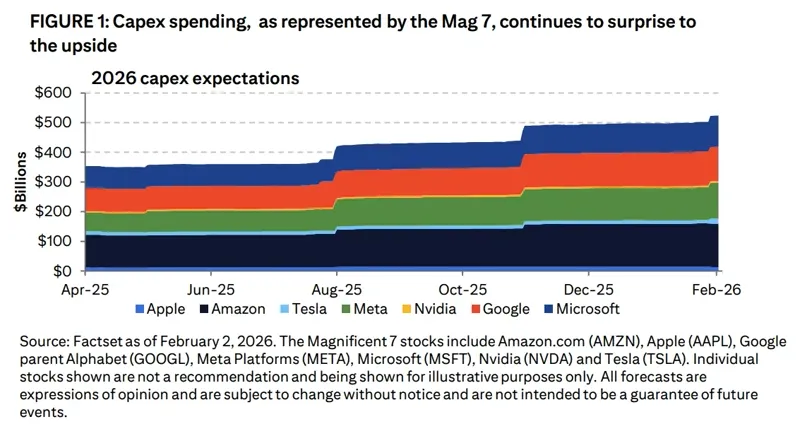
Big Tech companies will have to raise tens of billions of dollars to fund their skyrocketing investments in artificial intelligence this year, as capital spending outpaces cash flows even among some of the world’s most profitable companies. Google’s parent Alphabet, Amazon and Meta all surprised investors with the scale of their AI spending plans over the past two weeks. A total of more than $660bn is set to be ploughed into…
keep reading — 1 min ↗
234 Link 08 Feb 2026
source · bhuvan.substack.com ↗
I feel like a kid in a candy store thanks to AI coding tools.
keep reading — 1 min ↗
232 Musing 06 Feb 2026
Artificial general intelligence (AGI) for normal people is here.
keep reading — 10 min ↗
231 Link 06 Feb 2026
source · x.com ↗
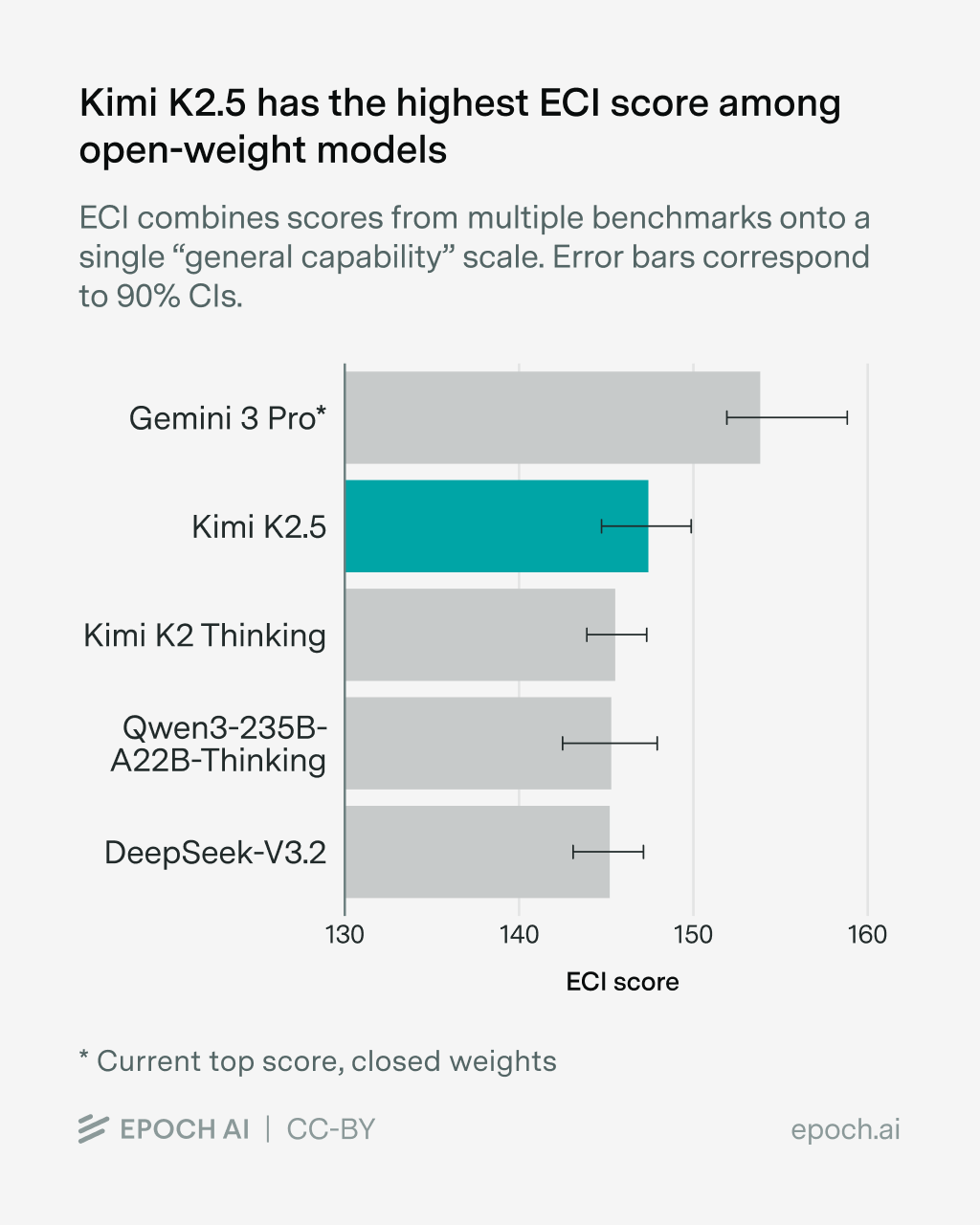
Kimi K2.5 set a new record among open-weight models on the Epoch Capabilities Index (ECI), which combines multiple benchmarks onto a single scale. Its score of 147 is about on par with o3, Grok 4, and Sonnet 4.5. It still lags the overall frontier.
keep reading — 1 min ↗
228 Link 04 Feb 2026
source · economist.com ↗
THERE is still time for the cheerful and the gloomy to disagree, sincerely, about the net impact on employment from automation and artificial intelligence. Perhaps AI will unleash a job-creating economic boom for the ages, as boosters maintain. Maybe on balance the doom-mongers are right, and grim legions of algorithm-guided bots and robots will conquer one industry (and profession) after another. One outcome is not up for…
keep reading — 1 min ↗
225 Link 03 Feb 2026
source · nymag.com ↗
It’s sort of hard to know how to read a manifesto like this from one of the most powerful figures in tech. Is it a sober, strategic precursor to policy papers for the next administration? The highest-profile episode of AI psychosis yet? A lament about the problems of today written in the technological dialect of tomorrow? If you take out the AI, it reads like a social-democratic electoral platform full of reforms and…
keep reading — 2 min ↗
219 Link 31 Jan 2026
source · niemanlab.org ↗
As news publishers try to safeguard their contents from AI companies, the Internet Archive is also getting caught in the crosshairs. The Financial Times, for example, blocks any bot that tries to scrape its paywalled content, including bots from OpenAI, Anthropic, Perplexity, and the Internet Archive. The majority of FT stories are paywalled, according to director of global public policy and platform strategy Matt Rogerson.…
keep reading — 1 min ↗
211 Link 28 Jan 2026
source · fast.ai ↗
With vibe coding, people often report not realizing until hours, weeks, or even months later whether the code produced is any good. They find new bugs or they can’t make simple modifications; the program crashes in unexpected ways. Moreover, the signs of how hard the AI coding agent is working and the quantities of code produced often seem like short-term indicators of productivity. These can trigger the same feelings as the…
keep reading — 2 min ↗
210 Link 28 Jan 2026
source · bloomberg.com ↗
AI can ruin your Hinge date. It can detect cosmic anomalies. It can make history come alive. But it cannot suspend the basic laws of economics, says Allison Schrager. Elon Musk’s recent prediction — that AI will make saving for retirement unnecessary — is complete hogwash in her eyes. Consider the following four scenarios. In the future, Allison says AI will either … 1.Make us more productive in the same way that railroads,…
keep reading — 1 min ↗
196 Reflection 23 Jan 2026
as a software engineer, i feel a real loss of identity right now. for a long time i defined myself in part by the act of writing code. the pride in a hard-earned solution was part of who i was. now i watch AI accomplish in seconds what took me hours. i find myself caught between relief and mourning, awe and anxiety. the craft that shaped me is suddenly eclipsed by a machine. who am i now?
keep reading — 3 min ↗
195 Link 22 Jan 2026
source · interconnects.ai ↗
Every engineer needs to learn how to design systems. Every researcher needs to learn how to run a lab. Agents push the humans up the org chart. I feel like I have an advantage by being early to this wave, but no longer feel like just working hard will be an lasting edge. When I can have multiple agents working productively in parallel on my projects, my role is shifting more to pointing the army rather than using the…
keep reading — 1 min ↗
194 Link 22 Jan 2026
source · stevenadler.substack.com ↗
I feel torn about whether the RLHF generation should count as ‘just predicting the next word,’ but the latest generation is a very clear “no” for me. This generation is even more different: The AI is presented during training with hard problems, and it thrashes around until it has learned a general skill of problem-solving. I know this sounds pretty wild, but it works; this is the technique11 that lets the AI outperform the…
keep reading — 2 min ↗
189 Musing 19 Jan 2026
"We are as gods and might as well get good at it."
keep reading — 3 min ↗
182 Link 16 Jan 2026
Summary by Claude. Let me break down what Jones and Tonetti are arguing. The Core Question How much of past economic growth came from automation, and what does that tell us about AI's future impact? The Key Insight: "Weak Links" The paper's central concept is that economic production involves complementary tasks — you need all of them to produce output. Think of it like a chain: your output is limited by your weakest link,…
keep reading — 3 min ↗
181 Musing 15 Jan 2026
To read.
keep reading — 1 min ↗
180 Link 14 Jan 2026
Since Claude can’t create the good abstractions. Claude’s powers are limited by how good the blocks you give it are. Have no illusions; Claude cannot reproduce Sentry and Terraform and Playwright. These are incredibly complex and well-designed pieces of code. And since Claude can’t create good abstractions on its own, there’s a limit to how much anyone can do with Claude alone. Even though everyone on X thinks you can…
keep reading — 1 min ↗
179 Link 13 Jan 2026
I was interpreting an odd statutory investment limitation today and got stuck (no guidance anywhere). Asked GPT-5.2 Pro to find examples of companies that have ever exceeded this investment limitation (which would disprove the contrary interpretation). GPT-5.2 Pro proceeded to trawl the internet for random places where financial statements of these regulated entities are available (there is no central database). Analyzed a…
keep reading — 1 min ↗
178 Link 13 Jan 2026
My guess: the virtual coworker coming next year is going to be something like a nice UI sitting on top of an agent operating your computer using mostly a command line, occasionally GUI use, with obscure bash commands translated to natural language by a tiny intermediary LLM. The agent will be able to designate subagents, probably, to do specific things behind the scenes. It'll be able to access many of the software and cloud…
keep reading — 2 min ↗
177 Musing 13 Jan 2026
That’s because humans didn’t just sit on their hands; rather, entirely new kinds of work were created, which were valued dramatically higher. Much of this was in factories, and then, over the last century, there was the rise of office work. All of that could very well be replaced by AI, but the point is that the history of humans is the continual creation of new jobs to be done — jobs that couldn’t have been conceived of…
keep reading — 6 min ↗
175 Link 12 Jan 2026
The new leverage comes from moving one layer up. Instead of doing every task ourselves, we design systems that can do them for us. A single agent can now execute autonomously what used to require long hours my time, freeing my attention for higher-level decisions, design, judgment. And maybe just... enjoying the life with my loved ones? This all immensely increases the leverage of single engineer. Technically, you're one well…
keep reading — 2 min ↗
172 Link 10 Jan 2026
Anything that can be automated should be. There’s no good reason humans should be making excel models or powerpoints in 10 years, any more than they should be hand-washing clothes. It’s toil and drudgery. What will remain? Anything we want to do because it’s fun or interesting. May be weird but I view automation as a moral imperative so that everybody can spend their time gardening or making art or playing chess or making…
keep reading — 2 min ↗
171 Musing 09 Jan 2026
the timeline is full of people using Claude Code to generate ads, recover corrupted video, make landing pages, manage business texts… the narrow view of coding agents is that they primarily decrease the cost of software development the ambitious view is that almost any problem/solution can be expressed in software and this capability is upstream of all knowledge work
keep reading — 6 min ↗
170 Musing 08 Jan 2026
The timeline is full of people using Claude Code to generate ads, recover corrupted video, make landing pages, manage business texts… The narrow view of coding agents is that they primarily decrease the cost of software development. The ambitious view is that almost any problem/solution can be expressed in software and this capability is upstream of all knowledge work.
keep reading — 1 min ↗
169 Link 08 Jan 2026
I totally see the value in the feature and I would like to find a way to add it. But the reality is that 75% of the people on our engineering team lost their jobs here yesterday because of the brutal impact AI has had on our business. And every second I spend trying to do fun free things for the community like this is a second I'm not spending trying to turn the business around and make sure the people who are still here are…
keep reading — 4 min ↗
168 Link 07 Jan 2026
If you’re thinking about starting an argument with “AI will eventually automate all jobs,” I’m begging you to (1) talk to a plumber and a kindergarten teacher, and (2) have an economist walk you through how a big increase in the efficiency of producing X impacts demand for not-X. “Not only do most jobs involve doing work in the physical world (plumbers), many jobs involve forming emotional relationships with other human…
keep reading — 1 min ↗
166 Link 06 Jan 2026
In fact, I have great optimism that one potential upside of AI is a renewed appreciation of and investment in beauty. One of the great tragedies of the industrial era — particularly today — is that beauty in our built environment is nowhere to be found. How is it that we built intricate cathedrals hundreds of years ago, and forgettable cookie-cutter crap today? That is, in fact, another labor story: before the industrial…
keep reading — 2 min ↗
164 Musing 05 Jan 2026
For most of its history, software has been closer to craft than manufacture: costly, slow, and dominated by the need for skills and experience. AI coding is changing that, by making available paths of production which are cheaper, faster, and increasingly disconnected from the expertise of humans.
keep reading — 3 min ↗
157 Link 03 Jan 2026
I’m not trying to push you in any direction, honest. If you get everything totally wrong, too bad, but you’ll still be remembered forever for trying. Even Pontius Pilate has immortality of a sort. Both Eliezer Yudkowsky and Beff Jezos have their page in the textbooks assured. If you’re a well-off Silicon Valley person, you’re already well-placed to join them. So participate in the discourse. Create some art. Donate to a cause…
keep reading — 1 min ↗
156 Link 02 Jan 2026
As a normal, non-technical person, I think we are living in magical times—and I say this because of LLMs, especially the LLM coding tools. As someone who doesn’t know a lick of programming, the fact that a person with absolutely no idea what coding is can still wrangle these tools and get useful things built is the…
keep reading — 2 min ↗
155 Link 01 Jan 2026
OpenAI in particular should beware hubris. One vc says discussion of cash burn is taboo at the firm, even though leaked figures suggest it will incinerate more than $115bn by 2030. Sam Altman, its boss, said recently that one reason he wants to take OpenAI public is to watch its doubters sell it short. “I would love to see them get burned on that,” he said. Plenty of investors seem prepared to take the bet: both the public…
keep reading — 1 min ↗
154 Link 01 Jan 2026
Our appetite for AI slop is likely to be similarly insatiable. The adoption curve we’ve seen so far may pale beside what happens when disposable software production becomes truly mainstream. If the democratisation of software mirrors the impact of ubiquitous photo, video, and audio capture enabled by the smartphone, we may see user-generated software created, shared, and discarded at social-media scale. Should that happen,…
keep reading — 1 min ↗
150 Musing 31 Dec 2025
This reflection was sparked by this tweet from Peter Steinberger, whom you should absolutely follow on Twitter and read on his blog. I came across his account recently and started reading his writing. For an amateur web coder, his blog is surprisingly rich with practical, thoughtful tips. I've also been poking around…
keep reading — 4 min ↗
149 Musing 30 Dec 2025
source · x.com ↗
The technology and models that ultimately elevate the craft will get lasting traction in Hollywood, while the prompt-based slop tools will focus more on social and content creator use-cases. Finally, the idea of personalized films with audience cameos will be humbled by the realization that people favor shared experiences. People want to be inspired by craft – and they want a common experience to discuss (or even share, in…
keep reading — 3 min ↗
148 Link 29 Dec 2025
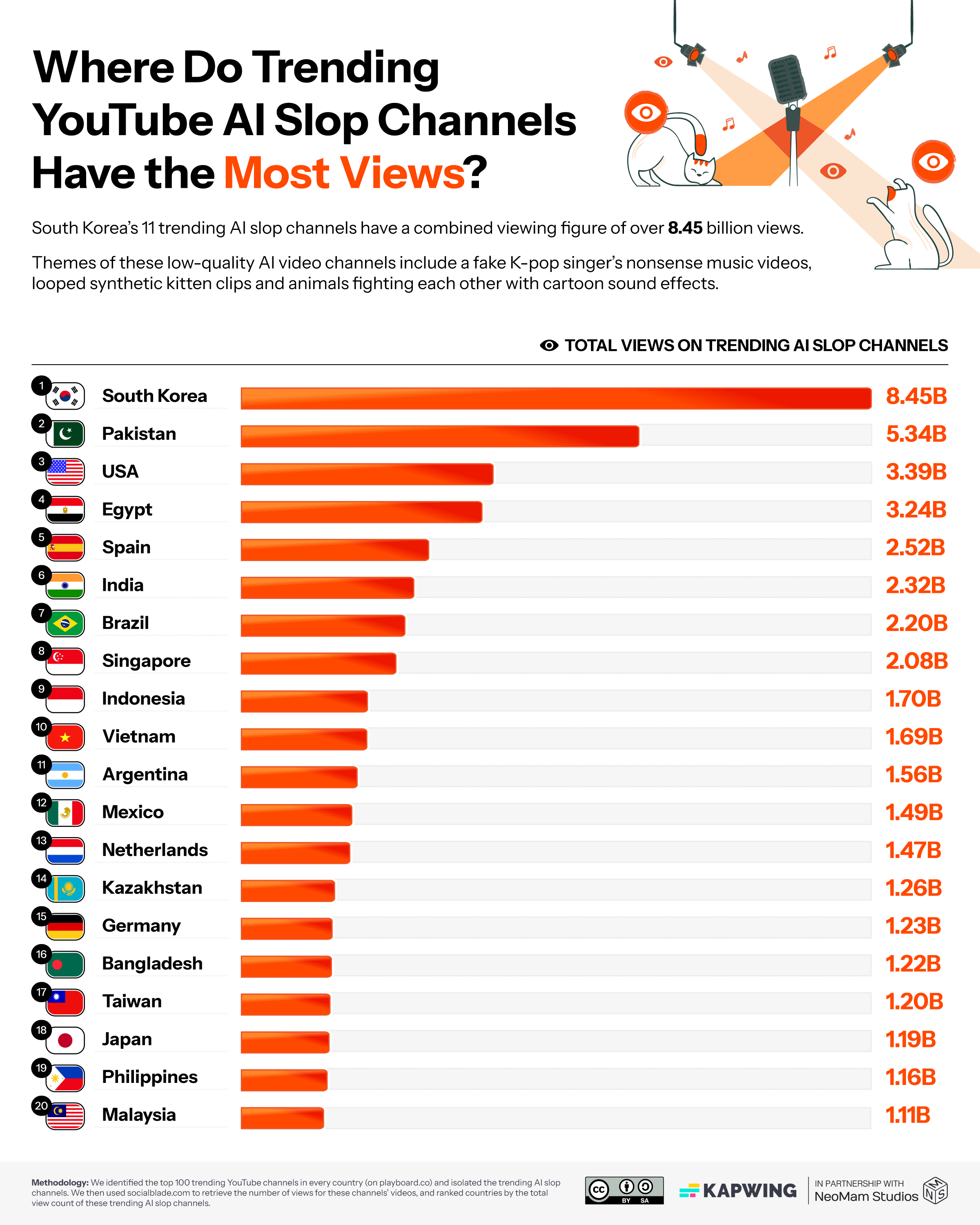
Five of the other ten trending AI slop channels with the most views are based in South Korea, with others in Egypt, Brazil and Pakistan. But the channel with the most views of all is in India. Bandar Apna Dost features over 500 videos, mainly “featuring a realistic monkey in hilarious, dramatic, and heart-touching human-style situations,” Many of which are variations on identical set-ups. The channel also has around 100,000…
keep reading — 1 min ↗
146 Link 29 Dec 2025
It’s incredible how far “vibe coding” has come this year. Whereas in May I was amazed that some prompts produced code that worked out of the box, this is now my expectation. I can ship code now at a speed that seems unreal. I burned a lot of tokens since then. Time for an update. It’s funny how these agents work. There’s been this argument a few weeks ago that one needs to write code in order to feel bad architecture and that…
keep reading — 2 min ↗
144 Musing 28 Dec 2025
When I created Claude Code as a side project back in September 2024, I had no idea it would grow to be what it is today. It is humbling to see how Claude Code has become a core dev tool for so many engineers, how enthusiastic the community is, and how people are using it for all sorts of things from coding, to devops, to research, to non-technical use cases. This technology is alien and magical, and it makes it so much easier…
keep reading — 2 min ↗
142 Reflection 27 Dec 2025
Andrej Karpathy: I've never felt this much behind as a programmer. The profession is being dramatically refactored as the bits contributed by the programmer are increasingly sparse and between. I have a sense that I could be 10X more powerful if I just properly string together what has become available over the last year and a failure to claim the boost feels decidedly like skill issue. There's a new programmable layer of…
keep reading — 10 min ↗
139 Link 25 Dec 2025
The core finding: even under generous assumptions about hardware efficiency and utilization, we are likely 8–50x short on compute for consumer inference alone in a mature agentic and multimodal world. This is before accounting for enterprise, sovereign, robotics, or training demand. Three claims underpin this framework: 1\. Tokens are the kWh of knowledge work. As price falls, users don't ask the same questions more cheaply;…
keep reading — 1 min ↗
138 Musing 25 Dec 2025
Infinitely self recursively improving systems are impossible. It's impossible to make a system that can correct all its own mistakes when it is the very thing making the mistake in the first place. How do I know? Evolution hasn't figured it out in millions of years, why would we figure it out in two or two hundred? Your brain is a bunch of crude hacks. Wonderful hacks and amazing hacks but crude nonetheless. When you have to…
keep reading — 1 min ↗
137 Link 24 Dec 2025
But the debt sales, tracked by trade body Sifma through to the end of November, also reflect an AI borrowing boom, as Big Tech groups including Meta, Alphabet, Amazon and Oracle tapped bond markets to fund data centres and the energy systems needed to power them. AI-related borrowing now accounts for about 30 per cent of net investment-grade issuance, according to Goldman Sachs, and is expected to grow in 2026, despite…
keep reading — 1 min ↗
136 Musing 24 Dec 2025
Claude Code is, with hindsight, poorly named. It’s not purely a coding tool: it’s a tool for general computer automation. Anything you can achieve by typing commands into a computer is something that can now be automated by Claude Code. It’s best described as a general agent. Skills make this a whole lot more obvious and explicit. I find the potential applications of this trick somewhat dizzying. Just thinking about this with…
keep reading — 2 min ↗
135 Musing 24 Dec 2025
tl;dr: AI is overdelivering. 55% of respondents say AI has exceeded their expectations, and almost 70% say it’s improved the quality of their work. More than half of respondents said AI is saving them at least half a day per week on their most important tasks. We’ve never seen a tool deliver a productivity boost like this before. Founders are getting the most out of AI. Half (49%) report that AI saves them over 6 hours per…
keep reading — 2 min ↗
134 Musing 24 Dec 2025
Most of AI progress has this flavor: if you have a bit of intellectual curiosity and some time, you can very quickly shock yourself with how amazingly capable modern AI systems are. But you need to have that magic combination of time and curiosity, and otherwise you’re going to consume AI like most people do - as a passive viewer of some unremarkable synthetic slop content, or at best just asking your LLM of choice “how to…
keep reading — 3 min ↗
130 Link 21 Dec 2025
This blog post by Tim Dettmers argues that the popular idea of \\Artificial General Intelligence (AGI)\\—an AI that can do anything a human can—and \\"superintelligence"\\—AI that becomes infinitely smarter than humans—are \\unrealistic fantasies\\ \[1, 2\]. He believes these concepts ignore the harsh realities of the physical world \[2, 3\]. Here is a breakdown of the key concepts to help you understand his argument: \### 1.…
keep reading — 5 min ↗
128 Link 20 Dec 2025
2025 is where I (and I think the rest of the industry also) first started to internalize the "shape" of LLM intelligence in a more intuitive sense. We're not "evolving/growing animals", we are "summoning ghosts". Everything about the LLM stack is different (neural architecture, training data, training algorithms, and especially optimization pressure) so it should be no surprise that we are getting very different entities in…
keep reading — 1 min ↗
126 Link 20 Dec 2025
To get a sense of the immense progress on predictive AI and its future potential, we can look at the trajectory of the past 20 years. In 2005, we couldn’t get AI to tell the difference between a person and a pencil. By 2013, AI still couldn’t reliably detect a bird in a photo, and the difference between a pedestrian and a Coke bottle was massively confounding (this is how I learned that bottles do kind of look like people, if…
keep reading — 2 min ↗
125 Link 20 Dec 2025
I agree with all this; it is why I also believe that opus 4.5 in claude code is basically AGI. Most people barely noticed, but \it is happening.\ It’s just happening, at first, in a conceptually weird way: Anyone can now, with quite high reliability and reasonable assurances of quality, cause bespoke software engineering to occur. This is a strange concept. Most people, going about their day, do not think about how "causing…
keep reading — 4 min ↗
123 Musing 18 Dec 2025
Humans should remain smarter than their refrigerators. It is insane that we are living in a time in which people are trying to make refrigerators smarter, but are satisfied to dumb down themselves and those around them. All the evidence suggests that AI is bad for your brain. If you use it as a salve for social and romantic frustration, it also makes it harder for you to connect with others and less resilient in the face of…
keep reading — 1 min ↗
122 Practical 16 Dec 2025
Interesting discussion on how good LLMs have gotten at coding. Some of the quote tweets on the link are also interesting.
keep reading — 1 min ↗
121 Link 15 Dec 2025
Turns out it was almost all built by LLMs At this point I went looking for some more background information on the library and found Emil’s blog entry about it: How I wrote JustHTML using coding agents: Writing a full HTML5 parser is not a short one-shot problem. I have been working on this project for a couple of months on off-hours. Tooling: I used plain VS Code with Github Copilot in Agent mode. I enabled automatic…
keep reading — 1 min ↗
120 Link 15 Dec 2025
The grave dangers AI safety hawks worry about can’t be adequately addressed without extensiveo international cooperation—cooperation tight enough to qualify as international governance. If, for example, your nation regulates AI skillfully enough to keep a bioweapon from being built on your soil, that won’t save you from the global pandemic that originates in a laxer nation; international regulation is needed. If you’re…
keep reading — 2 min ↗
117 Musing 13 Dec 2025
Here’s what I think will happen in 2026: AI platforms will start offering paid placement within conversations where clear purchase intent signals are evident. The ads will be clearly labeled as sponsored, and they will likely tie into direct purchase opportunities. Eventually, ads will also appear embedded in other types of interactions, such as inspiration (where should I take my family on spring break?) and research (what…
keep reading — 1 min ↗
102 Musing 14 Nov 2025
I'm confident that AI is not going to wipe out anywhere close to 25M jobs on net over the next decade. If technological shocks caused net, long-run displacement, employment in the US would be 0. Instead, it's among its highest peacetime age-adjusted levels. But... 1/2 ...AI could absolutely drive gross displacement; think of automobiles displacing horse-related jobs even as they created new types of auto manufacturing &…
keep reading — 1 min ↗
101 Practical 12 Nov 2025
Philippe Lemoine I think that if progress in generative AI continues, which I'm pretty sure it will (it doesn't even have to continue at the current pace as long as decreasing marginal returns don't hit too hard), cultural products will become massively diversified. One factor that limits the diversity of cultural products is that they tend to have high fixed costs, so you need a large enough audience for them to be…
keep reading — 1 min ↗
100 Musing 12 Nov 2025
in a post-AGI world, people will simply get used to the fact that computers can solve cognitive problems quickly, and beat us in any cognitive domain, just like we're used to computers multiplying large numbers quickly now, or kicking our asses in chess and go. software and math will lose all their scarcity. "pls create a MMORPG that is like Zelda: Breath of the Wild but with Pokémon instead, let me fly around the world as a…
keep reading — 3 min ↗
092 Musing 02 Nov 2025
I don't happen to believe AI is going to take away all of the jobs. But it is possibly a blindspot-generating issue that the people studying AI's impacts mostly love their jobs
keep reading — 1 min ↗
090 Reflection 31 Oct 2025
I would also now add a surprising element to my 2024 essay: as the cost of cognition approaches zero, that which is repeatable will be replaceable—and will indeed be replaced—by AI (a favorite saying of Palantir Co-Founder Stephen Cohen), which opens up an aperture for those who truly undertake creative acts. In short, we are going to be forced by the technology to be more creative; we will be impelled to do that which only…
keep reading — 1 min ↗
088 Musing 30 Oct 2025
The extent to which AI truly eliminates rip-off markets depends on two things. First, consumers need to know how to use AI properly. Mindlessly repeating advice from ChatGPT is less effective than using the bot as a learning tool that allows a consumer to negotiate more credibly. In this regard, the results of a trial by Jan Biermann, then of the University of Hamburg, John Horton of the Massachusetts Institute of Technology…
keep reading — 2 min ↗
087 Musing 29 Oct 2025
A lot of people are likening the advent of AI to moveable type. The printing press brought about the conditions for the Reformation, therefore significant institutional change is coming with AI. But when you look at how print changed cultures other than Europe, the picture gets muddied. In China, the "bureaucratic authority absorbed the technological impacts of printing to enforce cultural and social coherence." Rather than…
keep reading — 2 min ↗
086 Musing 29 Oct 2025
1. There is no standard definition of machine intelligence. There have been many attempts to give a definition or a metric of machine intelligence but most have been unsatisfactory. The lack of a common language makes work in this field difficult, but it’s also a big opportunity. 2. There is no standard model of AI’s economic impact. Economists have been using a wide range of assumptions to model AI’s impact, there is no…
keep reading — 2 min ↗
082 Musing 26 Oct 2025
The Question We Can No Longer Dodge If AI can already produce an A– college essay in 30 seconds — on demand, at scale — then what exactly is college for? Is it certification? Content delivery? A rite of passage? Social sorting? Because if a machine can now flawlessly mimic the outputs we’ve long treated as evidence of learning, then the value of higher education can no longer rest on product. It must rest on the formation of…
keep reading — 1 min ↗
079 Musing 25 Oct 2025
During the Q and A after his talk, Cowen said that LLMs are already “kicking our butt” at many things, including poetry. In fact, Cowen insisted, LLMs already write poems that are as good as the median poem by Chilean Nobel Prize-winner, Pablo Neruda. “Now, ex post, you can read one, read the other, and say, oh, only the real Neruda poem is meaningful to me because he’s a flesh and blood human, or was one. Like, fine. But ……
keep reading — 1 min ↗
064 Link 11 Oct 2025
A few good rabbit holes: 1\. The illusion of knowledge 2\. AI capex boom 3\. China and weaponized interdependence
keep reading — 1 min ↗
059 Practical 03 Oct 2025
I was able to use an extended conversation with an AI https://chatgpt.com/share/68ded9b1-37dc-800e-b04c-97095c70eb29 to help answer a MathOverflow question https://mathoverflow.net/questions/501066/is-the-least-common-multiple-sequence-textlcm1-2-dots-n-a-subset-of-t/501125#501125 . I had already conducted a theoretical analysis suggesting that the answer to this question was negative, but needed some numerical parameters…
keep reading — 2 min ↗
053 Link 30 Sept 2025
Agents are here. They can do real work, and while that work is still limited, it is valuable and increasing. But the same technology that can replicate academic papers in minutes can also generate 17 versions of a PowerPoint deck that nobody needs. The difference between these futures isn’t in the AI, it’s in how we choose to use it. By using our judgement in deciding what’s worth doing, not just what can be done, we can…
keep reading — 3 min ↗
043 Musing 19 Sept 2025
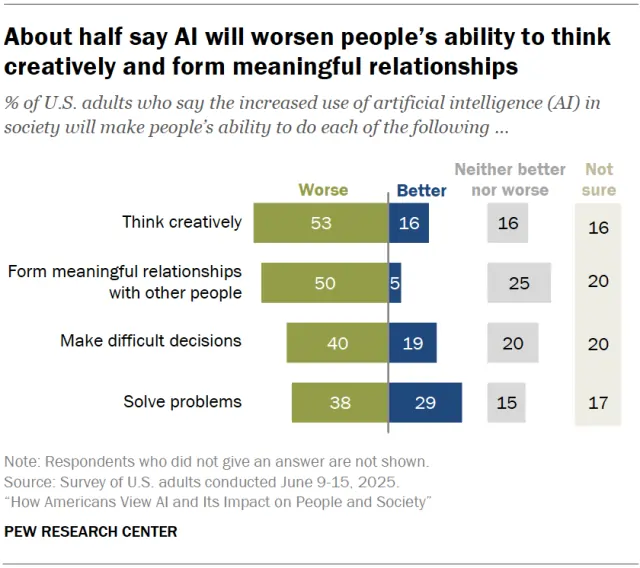
Americans are much more concerned than excited about the increased use of AI in daily life, with a majority saying they want more control over how AI is used in their lives. Far larger shares say AI will erode than improve people’s ability to think creatively and form meaningful relationships. At the same time, a majority is open to letting AI assist them with day-to-day tasks and activities. Most Americans don’t support AI…
keep reading — 2 min ↗
042 Reflection 18 Sept 2025
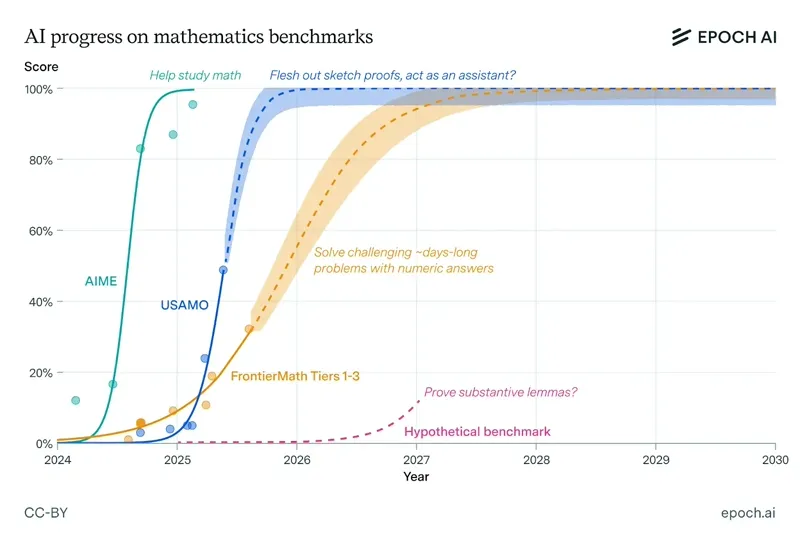
We officially competed in the onsite AI track of the ICPC, with the same 5-hour time limit to solve all twelve problems, submitting to the ICPC World Finals Local Judge - judged identically and concurrently to the ICPC World Championship submissions. We received the problems in the exact same PDF form, and the reasoning system selected which answers to submit with no bespoke test-time harness whatsoever. For 11 of the 12…
keep reading — 2 min ↗
036 Musing 11 Sept 2025
Yet a paper posted on February 10 (opens a new tab) left the math world by turns stunned, delighted and ready to welcome a bold new talent into its midst. Its author was Hannah Cairo (opens a new tab), just 17 at the time. She had solved a 40-year-old mystery about how functions behave, called the Mizohata-Takeuchi conjecture. “We were all shocked, absolutely. I don’t remember ever seeing anything like that,” said Itamar…
keep reading — 4 min ↗
031 Link 05 Sept 2025
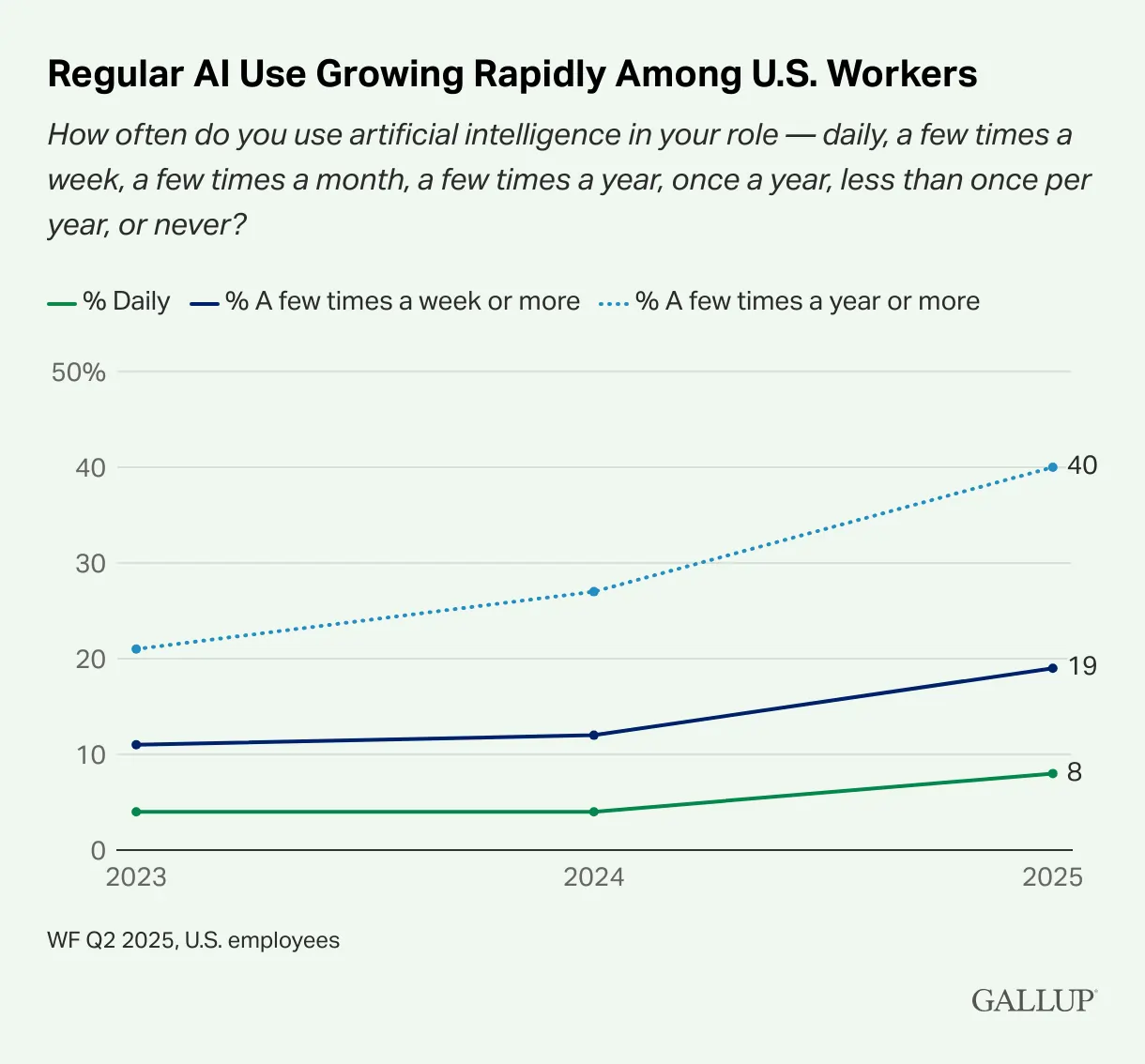
The policy, which takes effect immediately, will potentially apply to Chinese companies from ByteDance and Tencent to Alibaba. “We are taking action to close a loophole that allows Chinese companies to access frontier AI,” said the executive, who added that the policy would also apply to US adversaries including Russia, Iran and North Korea. The executive said the policy was designed “to align with our broader commitment that…
keep reading — 10 min ↗
029 Musing 03 Sept 2025
So, I was asked to come and explain AI again at SuperAI. I always think a good place to start if we want to understand this is to ask, "Well, what is it that we mean when we say AI?" This is a really important observation from 1970 from Larry Tesler, who was an AI scientist. He said, "AI is whatever machines can't do yet, because once it works, we say, 'Well, that's not AI anymore. That's just software.'" AI is the stuff that…
keep reading — 4 min ↗
028 Reflection 02 Sept 2025
"Any discourse about artificial intelligence is indistinguishable from talking out of your ass."
keep reading — 3 min ↗
024 Musing 29 Aug 2025
So, my verdict is: GPT top. Then there's a big gap. Then there's Grok, followed by Gemini 2.5, which might well be right that it's impossible. Gemini DeepThink, which really isn't worth the money, and at the very bottom, there is Claude. I think this illustrates what the current models are good for and what not. What they are good at: they're really good now at digging up related work and explaining it, which is good for…
keep reading — 3 min ↗
018 Musing 23 Aug 2025
AI-assisted writing allows you to have your cake and eat it too. The pleasure of the creative process, and the pleasure of reading. That’s in fact a test of good slop — do you feel like reading it? My understanding of what’s going on here is in my other AI-assisted-essay-about-AI from last week, about LLMs being similar to index funds for language. This essay could be considered my first modest AI-assisted viral hit. A lot of…
keep reading — 5 min ↗
017 Link 22 Aug 2025
It’s of course unclear what the future holds, but there’s a growing sense that the AI phenomenon is more bubble than boom. As such, rather than viewing the enterprise AI frenzy on Silicon Valley’s terms, as an inevitable jobs apocalypse, we have an opportunity to view it on material terms, and examine how it’s actually playing out on the ground. On those terms, we see managers, executives, and corporations using rebranded…
keep reading — 4 min ↗