Rabbit Holes a commonplace book,❦kept in the open
Tag · 12 folios

Economics

A pencil mark from the long tail. Browse the hand-chosen subjects for broader paths through the book.

462 Link

A tale of two Chinas

source blackrock.com

Outside China, the key question is whether companies use Chinese technology or compete against it. Cheaper Chinese industrial robots and machinery can boost productivity and ease labor shortages for their customers. For rival producers, the economics are less appealing. European machinery makers illustrate the squeeze. China has moved from a major buyer of advanced machinery to a formidable competitor at home and abroad. In…
keep reading — 2 min ↗
ChinaEconomics 4 threads →
460 Link

Indian government sucks at industrial policy

source The Hindu

I’d say that I am not against the government’s actions; I am very much for the government’s actions on dealing with the fundamentals. So let’s focus on public goods such as education and healthcare, let’s focus on building good roads, let’s focus on creating a good business environment, let’s focus on utilities, let’s focus on water, electricity, logistics. These are areas where you have a much better chance of success…

keep reading — 1 min ↗
Industrial policyRaghuram RajanEconomics 4 threads →
456 Musing

Galbraith’s Antidote to Economic Dogma

source en.wikiquote.org

I react to what is necessary. I would like to eschew any formula. There are some things where the government is absolutely inevitable, which we cannot get along without comprehensive state action. But there are many things — producing consumer goods, producing a wide range of entertainment, producing a wide level of cultural activity — where the market system, which independent activity is also important, so I react…

keep reading — 2 min ↗
EconomicsJohn Kenneth GalbraithCapitalism 4 threads →
454 Link

Mancur Olson on collective action

source Wikipedia

In his first book, The Logic of Collective Action: Public Goods and the Theory of Groups (1965), he theorized that what stimulates people to act in groups is incentive; members of large groups do not act in accordance with a common interest unless motivated by personal gain (economic, social, etc.). While small groups can act on shared objectives, large groups will not work towards shared objectives unless their individual…

keep reading — 1 min ↗
EconomicsMancur OlsenCollective action 4 threads →
435 Link

Research on the wealth effect

source Financial Times

Now, you might think that broader participation in the stock market would increase the strength of the wealth effect, with more households exposed to market volatility. But this is not quite right. ++New research++ from the Federal Reserve Bank of New York finds that the more widely Americans hold shares, the weaker the effect of a rate change on the real economy, which is the opposite of what you might expect: instinctively,…

keep reading — 1 min ↗
Wealth effectEconomicsMonetary policy 4 threads →
426 Link

How does the preference for sons impact the mental well-being of women in rural India?

source aces.illinois.edu

The researchers surveyed a sample of married women of reproductive age and their co-residing mother-in-law in Jaunpur district, Uttar Pradesh. When there was more than one daughter-in-law in the household, they included the youngest woman. They collected socioeconomic and demographic data, as well as information on mental health using a survey that screens for the risk of depression and anxiety. They found the strongest…

keep reading — 1 min ↗
Mental healthEconomics 4 threads →
364 Link

Is microfinance useful or useless?

The evidence base for microfinance being effective was always extremely thin. Morduch (1999), in an otherwise hopeful article on the development of microfinance, could not help but note the paucity of the available evidence that it was actually doing anything. The best evidence cited at the time for the Grameen Bank was Pitt and Khandker (1998), who used an eligibility requirement to infer the effect of the loans. However,…

keep reading — 2 min ↗
MicrofinanceEconomicsPoverty 4 threads →
218 Link

Some interesting facts

source Benthams on Substack

Lots of population numbers are pretty made-up. In many countries, there just isn’t really the infrastructure to do a good census. In Papua New Guinea, they’re not sure if the number of people is 9 million or 17 million. Similar things are true in other countries like Nigeria, which may have tens of millions more or fewer people than is standardly reported. In lots of countries, the way they get their official census numbers…

keep reading — 2 min ↗
ConsciousnessEconomicsBiology 4 threads →
073 Musing

Naked without values

This deterioration in the practice of politics can be attributed to many causes. One of the most important may be found in the deterioration in how economics is practiced. Economics is often described as a scientific discipline, which studies “if-then” propositions without reference to morals and values. But scientific findings do affect our values and normative judgments, and claims of “scientific objectivity” can be used to…

keep reading — 3 min ↗
EconomicsEqualityInequality 4 threads →
027 Link

Will the poor countries catch up the rich?

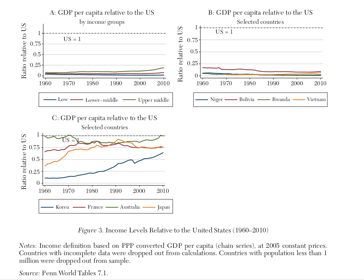
What Remains of Cross-Country Convergence? A Critical Review of 50 Years of Economic Growth Research. Summary by Claude. This comprehensive 2020 review by Paul Johnson and Chris Papageorgiou examines one of economics' most enduring questions: Do poor countries eventually catch up to rich ones? After analyzing five decades of research and data, their conclusions challenge popular narratives about global economic convergence.…

keep reading — 5 min ↗
DevelopmentEconomics 4 threads →