Everything blended, nothing understood
Post type: In-the-moment reflection
Epistemic status: Not very sure. I’m thinking this through out loud. This is more of a placeholder for future thought than a finished argument — something to return to with more reading, more perspectives, and more time. Treat it accordingly.
How this was written: I dictated the whole thing as a series of voice notes, dumped the monologue into Claude, and assembled the post with its help. The irony of using AI to write a post about the dangers of AI-assisted compression is not lost on me.
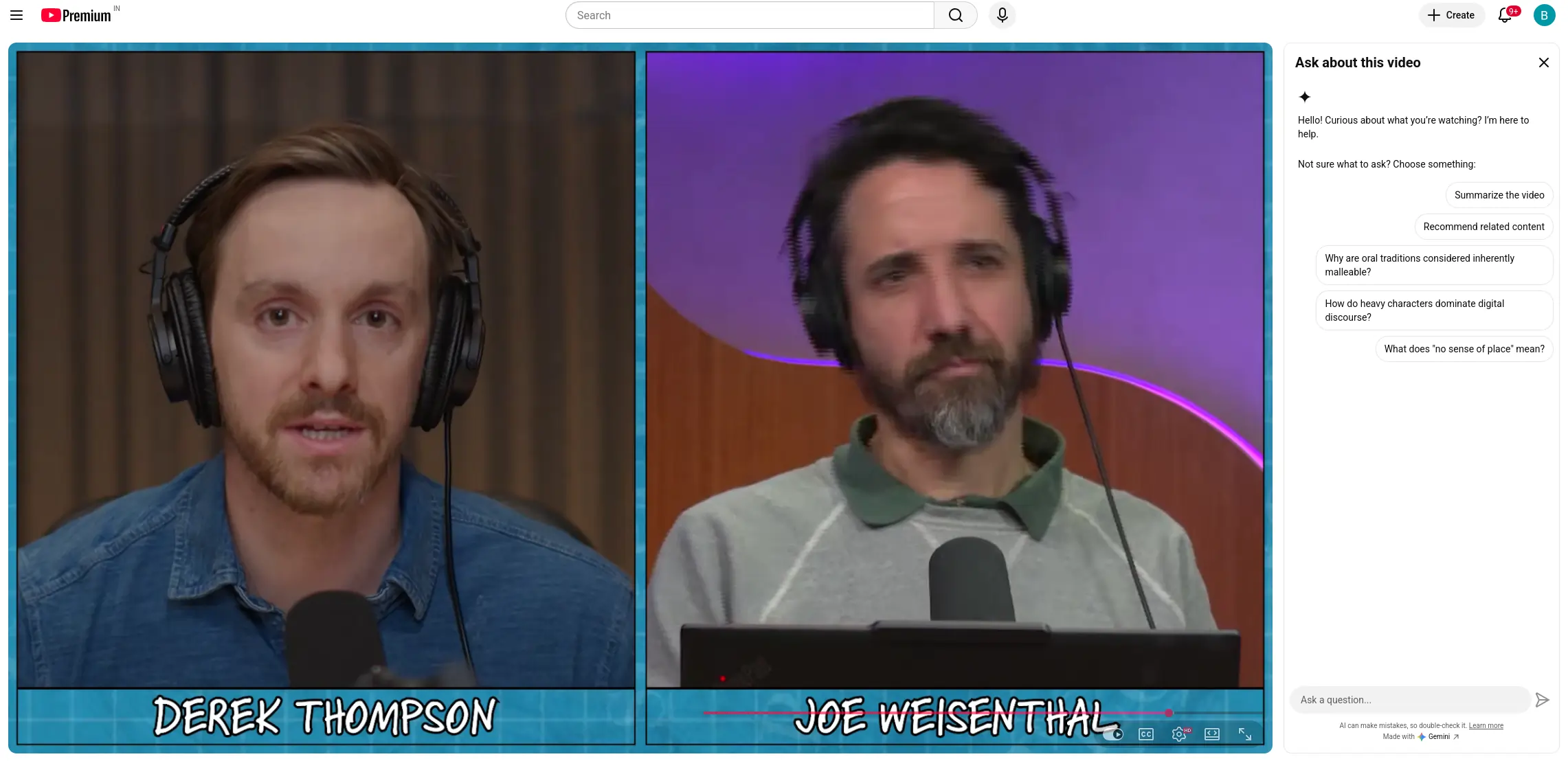
Something I’ve been thinking about for a while, but this particular post was prompted by that Gemini AI button you see under YouTube videos. Click on it, and one of the pre-selected prompts is “summarize this video.”
And it’s not just there. On Google Chat, if you haven’t read the last 10 messages, the first thing you see when you open a chat is a prompt to summarize them. More broadly, there’s been this anxiety that people don’t read, that reading is declining as a cultural habit, that we’re entering a compression culture where everything has to be stripped of nuance and context and delivered in bite-sized morsels.
As AI keeps getting better, and given that one thing it’s genuinely good at is transforming text, I keep wondering: what are the unintended consequences of this on how people read and think?
I don’t mean to be the old man complaining that everything is going to hell and every generation is getting dumber. But everything I see points in that direction. Maybe there are benefits I’m not seeing, and I’ll grant that possibility. But surely there are unintended consequences.
This isn’t an argument against summarization itself. I want to be clear about that. But being in finance, one thing I know is that the easiest way to induce a behavior is to remove friction at exactly the point where people might otherwise hesitate.
Zero-commission trading in the US led to a spectacular increase in options and crypto volumes. Easy access to prediction markets, where you can gamble on events supposedly tied to reality, has triggered what looks like an epidemic of gambling. Sports betting legalization, plus the massive advertising spend behind it, has caused nothing short of a gambling epidemic. And we know from research that the more steps between X and Y, the higher the dropout rate. The easiest way to keep people engaged is to reduce the number of steps. So this isn’t an empty worry. This is just how behavior works.
My concern isn’t that summarization is bad in itself. But if the ability to summarize is now widely available, something changes. Talk to anyone in media and they’ll tell you people are taking articles, dropping them into ChatGPT, and asking for a summary. After going through the five stages of grief, a lot of media sites have just added TL;DR buttons directly to their articles. They’ve basically given in.
Though TL;DR buttons aren’t new, to be fair. Even ten years ago, Digiday, the media trade publication, had TL;DR summaries on all their articles, and those were short-form pieces to begin with.
You see a strain of commentary that pins all of this on AI, but a lot of it was already happening in bits and pieces, long before AI entered the picture. None of this is uniquely an AI-era phenomenon, and I don’t want to make that false equivalence.
But the thing is: if supply of a particular good increases, demand reorients around it. Now that mass compression of text is available cheaply and at scale, and given that reading, comprehending, and thinking are inherently effortful activities for most people — and I don’t mean that pejoratively, because honestly, who actually enjoys plowing through a book — what does that do to people’s ability to grapple with complex issues? With nuance that doesn’t lend itself to easy simplification?
Let me be clear about something before going further. Not every article is meant to be read in full. Not every video deserves your complete attention. There’s a whole genre of observation that goes “this book should have been a blog post” or “this blog post should have been a tweet,” and there’s real truth to that.
There’s also just the reality of living through an informational deluge. Summarization isn’t always a choice — for a lot of people, it’s the only way to keep up with everything they want to consume. Whether they should be trying to consume that much is a separate question. But given that they are, compression is the only tool that makes it possible.
That being said, if supply of compression increases and mass adoption follows, what does that mean for the people on the production side? What happens to the people writing long-form, making thoughtful dense videos, doing the kind of work that doesn’t compress well?
The first-order impact seems obvious. If viewership falls off because easy alternatives exist, the people producing denser and more complex work will adapt. They’ll make things shorter. They’ll simplify. They’ll chase what gets consumed. That’s just how any ecosystem works. The producers respond to what the consumers do, the consumers respond to what’s available, and slowly the whole thing drifts. I’m doing amateur systems thinking here, so take it for what it’s worth, but a change in one part of a complex system always shows up somewhere else.
The second thing I keep thinking about is the difference between consuming something and actually understanding it.
They’re not the same thing. Understanding something, really understanding it, comes from wrestling with it. From sitting with it long enough that it starts to interact with stuff you already know. From being genuinely uncertain and not immediately resolving that uncertainty. From holding two things that contradict each other at the same time without collapsing into one side.
Mass compression can easily give people a false sense of having done that. And we were already bad at this before any of this existed. The illusion of knowledge is old. It’s probably baked into us for evolutionary reasons, a shortcut that was useful when life was simpler. But cheap and frictionless summarization makes the illusion easier to sustain and harder to puncture.
I kept coming back to this George Carlin bit while writing this. The rant about Americans shuffling through malls, eating everything, thinking about nothing. It’s funny, obviously, but underneath the comedy is a pretty accurate picture of what passive consumption as a cognitive posture looks like. He was describing the same destination I’m worried about.
Same with Idiocracy, which is genuinely one of my favorite movies and my default mental model for the direction things are headed. The movie isn’t really about people being inherently stupid. It’s about what happens when you remove all the conditions that make thinking necessary.
The obvious objection is that people have been saying this kind of thing forever and democracy has held up. And look, that’s a fair point. I can’t easily dismiss it. But I’m not sure it’s as comforting as it seems.
Walter Ong was a Jesuit priest and scholar who wrote Orality and Literacy in 1982. His argument was that the shift from spoken to written culture didn’t just change how people communicated, it changed how they thought. Literacy made introspection possible. It made sustained abstract reasoning possible. A lot of what we take for granted about how modern institutions work is downstream of that.
There’s a debate happening right now about whether we’re heading back the other way. Joe Wiesenthal, who co-hosts Bloomberg’s Odd Lots podcast, went on Derek Thompson’s Plain English earlier this year and argued that this shift explains, in his words, “99% of everything.” His case is that TikTok, Twitter, podcasts, short-form video, all of it has the characteristics of oral culture rather than literate culture: conversational, immediate, built around memorable formulas rather than careful argument. Thompson’s line was that maybe the age of social media was the revenge of orality.
Worth saying that this framework has its critics and plenty of scholars think it’s overstated. But you don’t need to buy the whole theory to notice the direction of travel.
If there’s something to it, then mass compression isn’t just a convenience feature. It’s piling onto a shift that was already underway. And what’s at stake isn’t just what people read. It’s what people are able to think.
Which gets me to the question I kept circling: what does this mean for democracy?
My gut says it’s bad. A citizenry running on blended smoothies, where everything has been pulped into frictionless goop, probably doesn’t produce great democratic outcomes. That seems like a reasonable assumption.
But I’ll be honest: I haven’t thought hard about the other side of this. Maybe there are upsides I’m not seeing. Maybe my inability to see them is just a failure of imagination or a gap in my historical knowledge. Every major informational shift — the printing press, mass literacy, radio, television — had people convinced it was the end of civilization. Every single one turned out to be more complicated than that. I’m open to the possibility that I’m doing the same thing here.
I don’t have a tidy conclusion. This is just where the thinking is.
Nearby leaves, connected by subject and form.